
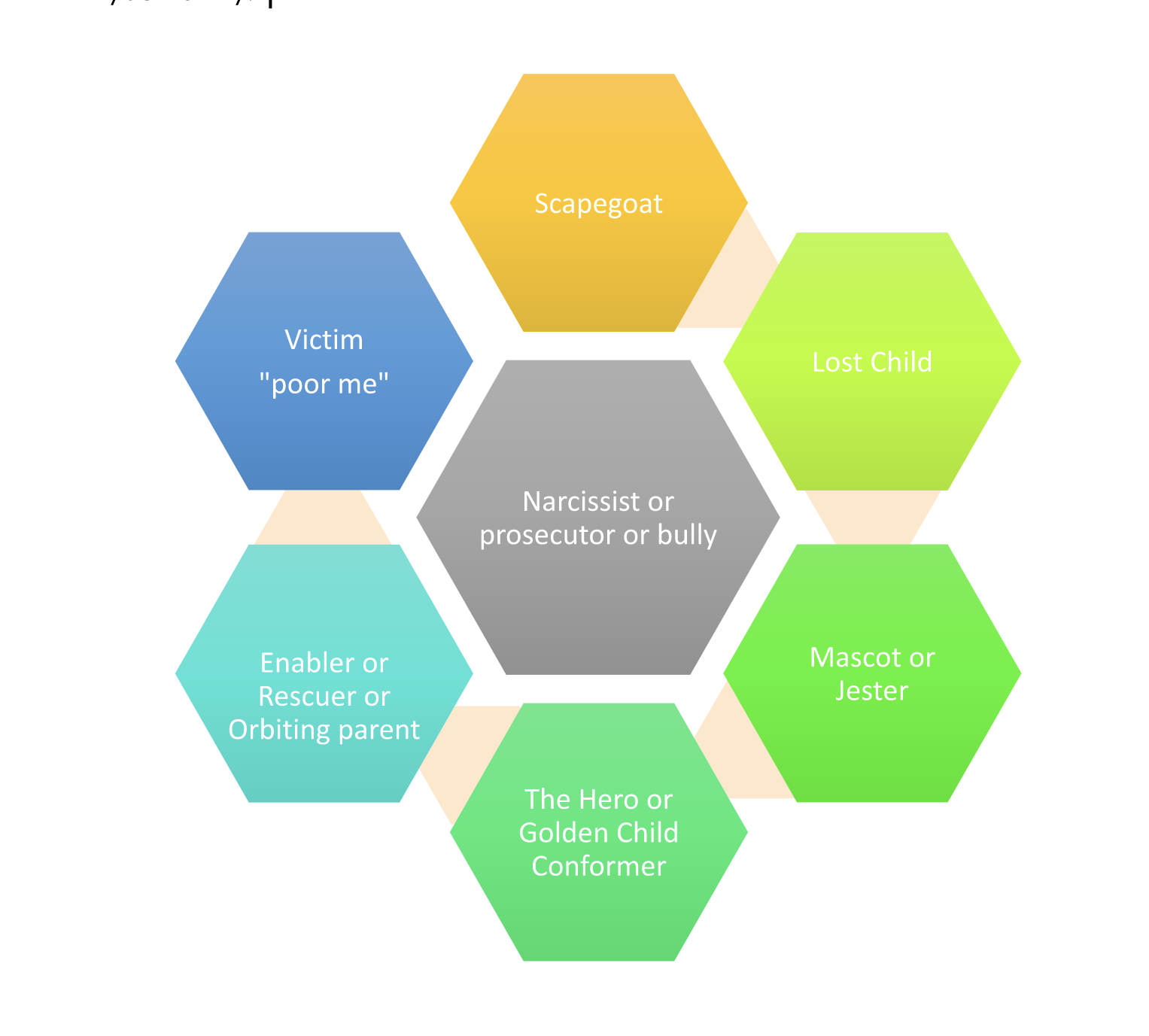
Narcissistic Families – Seven character roles families play?
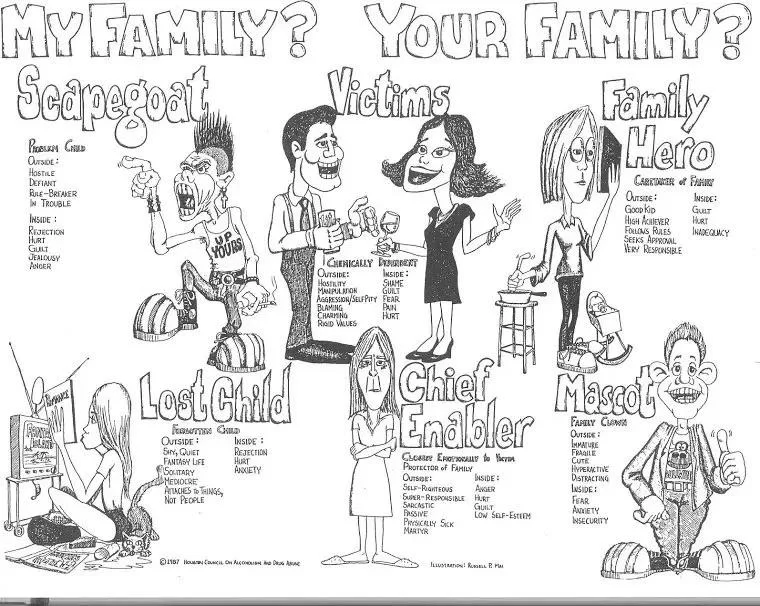
Scapegoat
A misunderstood, hopeless, blamed child who is seen as a trouble maker. They come across as rebellious, wild, defiant, rude at times. Always blamed this takes a massive hit on the self esteem. The Scapegoat is also referred to as the “black sheep” of the family, and has a hard time fitting in and relating to the other family members.
Lost Child
The Lost Child feels alone and misunderstood. They feel like a burden to the family on the inside and are prone to depression, and even suicide. Being undervalued plays havoc on the subconscious. The lost child is seen as a dreamer or the quiet, creative, independent, agreeable, artistic one.
Hero or Golden Child Conformer
A responsible, respectful, successful, probably ordered child that is an over-achiever and tends to receive a high amount of praise and positive attention. The hero’s presents the image of a family that is perfect, thus the need for their role.
Mascot or The Jester
Another of the 7 Narcissistic Family Roles is the funny, goofy, often immature, and does anything for a laugh. Often mascots are described as cute. The mascots role is to break the tension and lighten the mood with humour or antics.
Victim
Enabler or Rescuer or Orbiting parent
Persecutor or Narcissist
What does it matter if a parent is a Narcissist? Children have to survive and because they need to do that, it is built into them to be as sharp as nails. The emotional stuff they cannot make sense of or handle, gets suppressed or distorted until they are mature enough to process it all and place it in their brains appropriate memory folder, as they lay these matters from childhood to rest.
A narcissist parent won’t acknowledge the child’s feelings. They will compete with the child so as not to be out done. This kind of parent will constantly send mixed messages, manipulate, often blatantly lie and play mind games with the children to get their way and maintain control. In response the children will learn to seek external validation rather than internal. Drug addiction for example, may be one such outcome. The children will feel neglected, abused and may even suffer symptoms of emotional incest. Their self esteem will take a bad, long term blow and trauma work in a therapists chair will more often than not be the intervention needed to escape the cycle. Lest the next generation falls prey to the consequences of the roles played in the narcissistic family.
Thus the child will not be able to build feelings of trust. Trust is what all relationships are built on.
“The typical adult from a narcissistic family is filled with unacknowledged anger, feels like a hollow person, feels inadequate and defective, suffers from periodic anxiety and depression, and has no clue about how he or she got that way.”
—Pressman and Pressman, The Narcissistic Family
One parent can be narcissistic and the other parent can be the enabler or the rescuer while the child in the middle ends up as the victim. The Narcissist smashes the confidence, tells weak, stupid, less than the others. Th enabler pacifies, protects, coerces and manipulates the other family members to keep homeostasis. But the sad and sorry judgements of the narcissist are too harsh. The critic strikes fear into their victims, as narcissists do and dominates this way. Not even a word has to be spoken family rules and triangulation and family systems all make it unfold until the goal is met. Ego of narcissist is fed by the compliant and not so compliant. By the hero’s, the scapegoats and the lost ones.
When a parent or caregiver, or even a child that has grown up and through a traumatic upbringing in a narcissistic family, the best thing you can do is start to confront the issues head on. Do the work personally and get into therapy and heal. Don’t minimize the issues, as it is very likely they will persist. Worse still that the issues will be passed on, like some sick, hereditary curse. The good news, please don’t discredit the good news is that good traits, attitudes, talents, rules and roles are also passed down through families. They can be much more powerful in adulthood than any disease or trauma that one may have had to bear. Yes, this is all very treatable and curable. So don’t stay stuck. Get help from professionals, outside of the family circle, away from the silent and some not so silent rules and roles of the narcissistic family system.
Imagine of perfection and normalcy is goal to outside world. Feelings are not spoken about and oftentimes ignored.
SEVEN CHARACTER ROLES FAMILIES PLAY
There is a lot around these roles so we get to the point with the explanations of each. They are very easy to recognize, once you know what they are. Then the focus is good family systems therapy work to set yourself, the kids or other loved ones free from the consequences of the family system. Most importantly know that many addictions, depression, personality or mood disorders are treated by uncovering these unspoken family secrets and systems. Addicts that I have treated over the last 23 years have all had an enabler! All addicts have enablers, says the most recent data on the subject. Stopping the unhealthy roles and changing them for healthier, new rules and rules is the work that we do.
Work on the trauma egg is ideal for people who want to explore some of their own therapeutic work at home or by themselves.
HOW TO AVOID NARCISSISTIC FAMILIES AND THE 7 Narcissistic Family Roles
- Honesty. Nothing works better at healing this and almost all other negative family systems models. Just don’t keep secrets betwixt and between, spoken or unspoken. Speak up and speak honestly. Nothing will develop more healthy mechanisms, rules and roles than this.
- Forget the family image. Just settle on a normative and honest image. Don’t fake it.
- Be open and communicate properly. Keeping secrets keeps families sick.
- Don’t triangulate. Parents must be parents and siblings and kids must be what they are. Don’t make them what they are not, even if they are willing to play mom or day, it doesn’t work. Create clear boundaries and decent family hierarchies, that are open and positive.
- Don’t play the blame game. Be quick to forgive and move on. Each day anew is sunshine for the soul. This is how we escape the 7 Narcissistic Family Roles and grow and heal.
- All family members need permission to fail, permission to succeed, to be, to grow and learn.
- Seek a spiritual path and follow spiritual principles. When healing starts these principles will already be in place.
- Flexible families flourish. Don’t minimize the rigid, authoritarian parent. It is known to be the most damaging kind of parent there is on the planet. Yes, it is even worse than a parent who ignores the child and let’s them do what they want. We meet so many people in therapy who are over policed and over parented by authoritarians. It can create the worst kind of trouble for the child and the family. Authoritarian or Narcissistic? You decide on definitions as they apply to your family.
For more information on the 7 Narcissistic Family Roles get in touch sanctuaryplett@gmail.com
 Inpatient Treatment for Depression & Anxiety